

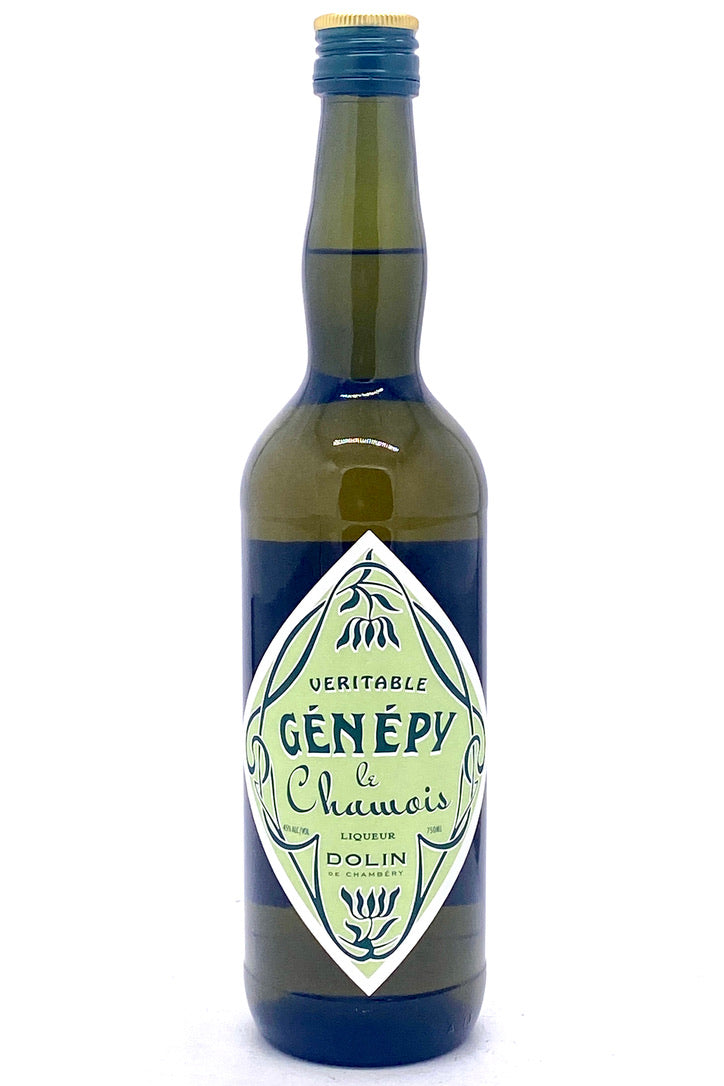
PRODUCT DESCRIPTION
Génépy and Chartreuse share the same mountain heritage, the same tradition of alpine botanical liqueur production, and — most importantly — the same primary botanical: artemisia, also known as mountain sage or wormwood, the wild alpine plant found principally in the high mountains of the Savoy, whose specific herbal, cooling, and aromatic character defines both liqueur styles. Understanding that connection is the key to understanding why Dolin Génépy le Chamois is, of all the herbal liqueurs available, the most credible, the most historically grounded, and the most specifically appropriate alternative to Chartreuse when Chartreuse is unavailable or when its price point makes a cocktail application impractical.
The difference is one of scale and complexity: Chartreuse uses 130 botanicals in a formula known only to two Carthusian monks, aged in large oak casks, bottled at 54% ABV. Génépy focuses more narrowly, with artemisia as the defining and dominant botanical among its 30-plus alpine herbs, bottled at 45% ABV without the extended oak aging. The result is a flavor profile that one reviewer specifically and accurately characterized as "like a stripped-down Yellow Chartreuse — intense sweetness, herbal bite, but it's in that flavor profile." For Last Word cocktails, Bijou cocktails, Swizzles, or any recipe that calls for Chartreuse, Génépy delivers the essential aromatic character — the alpine herb quality, the cooling mint, the sweet-bitter structure — at a more accessible price point and without the allocation challenges that the Chartreuse supply reduction since 2019 has created.
Maison Dolin has been making Génépy from local farmers' herbs in its own alembic still in Chambéry since 1821 — the same year the house was founded by Joseph Chavasse, the same family business that has passed through five generations of the Sevez family and that remains one of the last independent producers of Vermouth de Chambéry. The 1867 Paris Universal Exhibition awarded it a Gold Medal. It was a closely guarded regional secret until 2013, when Dolin finally began exporting it beyond France's borders — today it is the darling of French ski resorts and fine dining, served on the rocks, with tonic water, or after a fondue. In the American market, it has quickly become the most respected and the most specifically credible alpine herbal liqueur available outside of Chartreuse itself.
Maison Dolin was founded in Chambéry in 1821 by Joseph Chavasse, whose son-in-law Ferdinand Dolin inherited the recipe and gave the company its now-eponymous name. Today it operates in its fifth generation under the Sevez family — a family-owned and proudly independent producer of Vermouth de Chambéry and alpine herbal liqueurs from its home in Chambéry, the capital of France's Savoie region in the Auvergne-Rhône-Alpes. Chambéry holds France's only AOC designation for vermouth, awarded in 1932 — and Dolin is the last remaining producer making authentic Vermouth de Chambéry according to the principles that earned that AOC.
The Génépy le Chamois is produced from artemisia mutellina — mountain sage, a petite variety of the artemisia genus found principally in the high mountains of the Savoy, hand-harvested from alpine slopes during midsummer at peak aromatic intensity — alongside 30-plus additional locally sourced alpine herbs whose identities form part of the Dolin house recipe. The production approach is specifically and deliberately artisanal: real plant maceration rather than pre-prepared infusions, distillation in Dolin's own copper alembic still, and sweetening only by grape must, wine, and/or sugar rather than artificial sweeteners or flavorings. Every component is sourced from local farmers and from the alpine meadows above Chambéry whose wild botanical diversity has sustained the regional liqueur tradition for centuries.
Génépy and Chartreuse share the same foundational alpine DNA. The artemisia (wormwood/mountain sage) that defines Génépy's character is also one of the most prominent botanicals in Chartreuse's secret 130-botanical formula — which is why Génépy specifically, of all herbal liqueurs, occupies the position of most credible and most appropriate Chartreuse substitute rather than any other alpine amaro or Italian digestif.
The practical differences to communicate to customers: Génépy is slightly lower proof (45% vs Green Chartreuse's 54%), somewhat less complex (30+ botanicals vs 130), and considerably more focused on the artemisia's mountain sage and cooling herbal quality rather than the broader, more aggressive multi-botanical spectrum that Chartreuse delivers. The flavor sits, as multiple reviewers independently confirm, "somewhere between modern absinthe and Chartreuse" — pungent, herbaceous, with a sweet mouth-coating entry that transitions into a long, warming mint, candy cane, and lavender finish, the bitterness and sweetness genuinely and specifically balanced rather than dominated by either.
In cocktails, Génépy performs as an effective 1:1 substitute for Chartreuse in Last Word, Bijou, Swizzle, and Widow's Kiss applications. The lower proof means the cocktail may be slightly less intense — a splash more Génépy (¾ oz rather than ½ oz in a Last Word, for example) compensates directly. Given the Chartreuse supply reduction and consequent price increases since 2019, Génépy at 45% ABV and its specific production heritage makes it the most genuinely credible and the most specifically appropriate available alternative.
Nose
Fresh
alpine herbs and wildflowers leading,
with artemisia's specific
mountain sage character immediately
and unmistakably apparent.
Anise and mint emerge alongside
the herbal freshness, with
subtle spice adding warmth
beneath the cooler botanical
notes. Chamomile adds a delicate
floral secondary quality. The nose
is bright, inviting,
and specifically and memorably
associated with mountain air and
alpine meadows — exactly what a
two-century tradition of Savoyard
liqueur production produces when
made from real plants rather
than extracts.
Palate
Pungent and herbaceous with a
sweet mouth-coating entry — the
artemisia's natural bitterness and the
grape-must sweetening in specific
and genuinely elegant balance.
Mint and chamomile carry the
most cooling and the most
herbal mid-palate character, with
eucalyptus adding a subtly
medicinal secondary quality. The
sweetness is genuine but not cloying,
held precisely in check by the
herbal bite that defines this
style. The flavor profile —
between absinthe and Chartreuse —
is genuinely and
specifically accurate: more focused
than Chartreuse's
130-botanical complexity, more
refined and less
anise-aggressive than absinthe.
Finish
Long and warming, with candy
cane and lavender most persistently
characterizing the close. Mint and
artemisia linger with the most
specifically cooling and the most
specifically alpine quality available
in any French herbal liqueur at this
price point. Gently bitter, refreshing,
and genuinely satisfying as a digestif.
| Category | Details |
|---|---|
| Style | Alpine Herbal Liqueur — Génépy |
| ABV | 45% |
| Producer | Maison Dolin — Chambéry, Savoie, France |
| Founded | 1821 by Joseph Chavasse |
| Family | Five generations of the Sevez family |
| Also Produces | Vermouth de Chambéry (France's only AOC vermouth) |
| Primary Botanical | Artemisia mutellina — mountain sage/wormwood, hand-harvested from alpine slopes |
| Additional Botanicals | 30+ locally sourced alpine herbs |
| Maceration | Real plant maceration — no pre-prepared infusions |
| Still | Own copper alembic still in Chambéry |
| Sweetening | Grape must, wine and/or sugar only — no artificial sweeteners |
| Awards | Gold Medal — 1867 Paris Universal Exhibition |
| US Availability | Exported from France since 2013 |
| Chartreuse Connection | Artemisia is a primary Chartreuse botanical — Génépy is the most credible Chartreuse alternative |
| Flavor Position | Between absinthe and Yellow Chartreuse — herbal, sweet, cooling, bitter |
| vs. Green Chartreuse | Less proof (45% vs 54%) · Fewer botanicals (30+ vs 130) · More artemisia-focused · More accessible price |
| Cocktail Use | Last Word · Bijou · Swizzle · Widow's Kiss — effective 1:1 Chartreuse substitute |
| Best Served | Neat · On the rocks · With tonic · In hot cocoa · After fondue |
| Aromas & Flavors | Alpine herbs, mountain sage, anise, mint, chamomile, lavender, candy cane, eucalyptus, wildflowers |
| Bottle Size | 750ml |
Last Word (Génépy variation)
¾ oz
Dolin Génépy · ¾ oz gin · ¾ oz
maraschino · ¾ oz fresh lime juice. The
original Last Word calls for
Green Chartreuse; Génépy
delivers the essential alpine
herbal character at a more
approachable price point.
Génépy & Tonic
2 oz Dolin Génépy ·
3 oz premium tonic · lemon or
cucumber garnish. The most
specifically French and the most
specifically Alpine serve — the
"darling of French ski resorts" in its
most natural form.
Génépy Neat or On the Rocks
The
most traditional serve in Savoie — the
mountain sage and cooling herb
character most fully expressed
without dilution or mixers.
Hot Génépy Cocoa
1 oz Dolin Génépy
· 5 oz hot chocolate · whipped
cream. The traditional après-ski
serve, combining the alpine herbal
character with chocolate's richness in
the most specifically Savoyard
seasonal application.
Bottle Size: All bottles are 750ML/700ML unless otherwise noted.
21 and Over: Adult Signature Required
Your cart is empty
Start shopping
